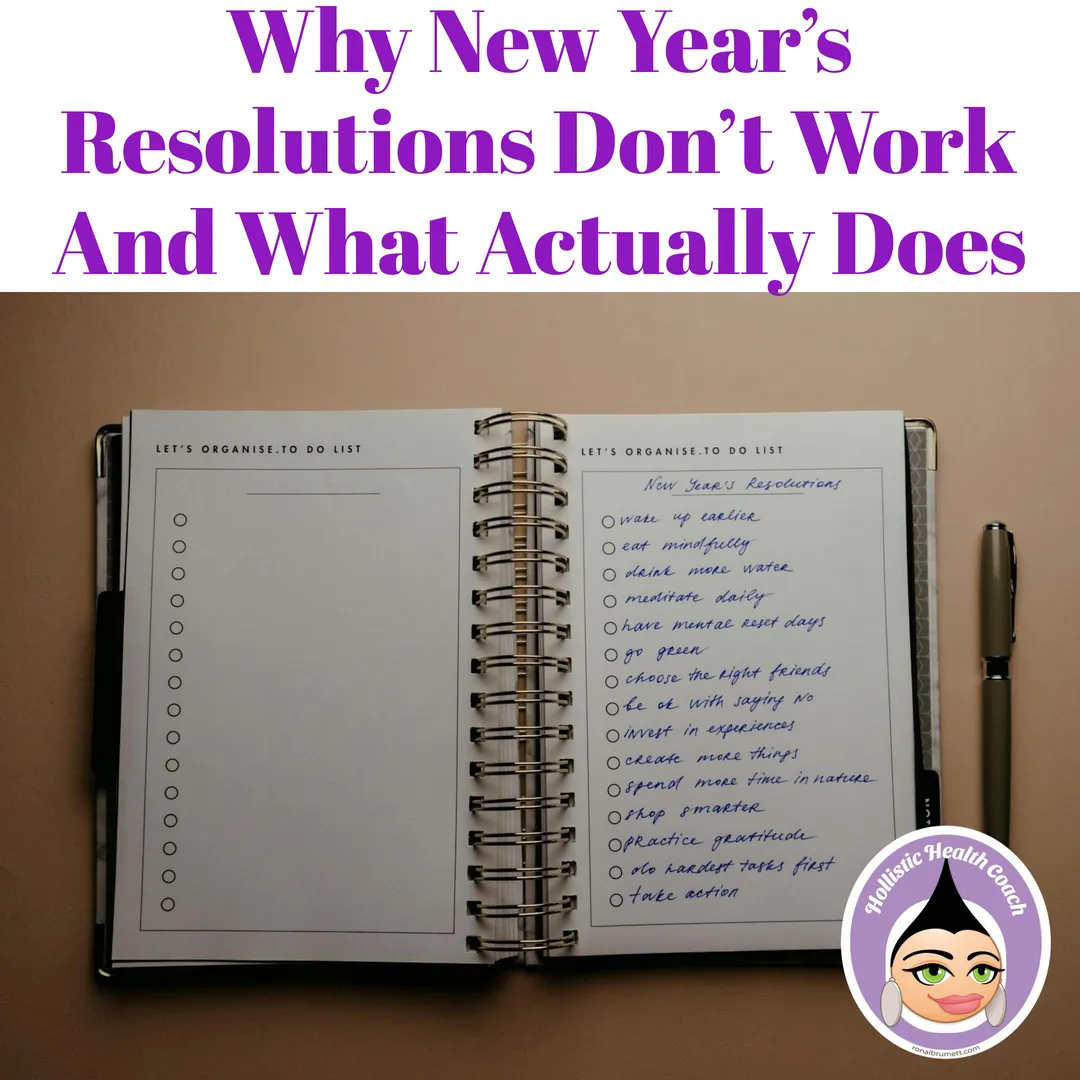
Why New Year’s Resolutions Don’t Work And What Actually Does
Hey, it’s Ronai!
Every January, millions of people make all sorts of resolutions.
“This is the year I finally get my life together.”
“This is the year I will finally be disciplined.”
“This is the year I will get healthy.”
“This is the year I will stop doing the things I know are not good for me.”
And by February, most of those resolutions are quietly abandoned like a gym membership that sounded like a great idea on January 1st.
Here is the truth no one likes to admit. New Year’s resolutions fail because they are behavior based, not identity based. They are built on pressure instead of understanding.
They ask you to force change without honoring how your brain, body, and spirit are actually wired.
Let’s fix that.
The Brain Does Not Like Forced Change
From a neuroscience standpoint, most resolutions rely on willpower. Willpower lives in the prefrontal cortex, which is the part of the brain responsible for planning, decision making, and self control.
The problem is that this part of the brain gets tired quickly, especially under stress. Shocker, I know.
When stress increases, the brain defaults to familiar patterns because they require less energy. This is why people often fall back into old habits even when they genuinely want to change.
This is not a character flaw. It is biology.
Sustainable change happens when the brain feels supported, not punished.
Why Strengths Based Growth Works Better
Every person processes motivation, stress, and growth differently. Some people thrive with structure. Others need flexibility. Some people are energized by connection. Others need quiet reflection.
This is why a single system never works for everyone.
Frameworks like CliftonStrengths are effective because they recognize that people are designed differently on purpose.
When people work in alignment with their natural strengths:
Their nervous system experiences less stress
Motivation increases naturally
Habits feel more sustainable
Growth feels supportive instead of exhausting
When people work against their strengths:
Burnout increases
Resentment builds
Quitting becomes more likely
Here is a super cool fact. Strengths based growth is supported by decades of positive psychology research. It does not ask people to become someone else. It helps them grow as who they already are.
Gratitude Isn’t “Woo Woo.” It Is Brain Chemistry.
Gratitude is often dismissed as fluffy or unrealistic. In reality, it is one of the most researched tools in neuroscience and psychology.
Studies show that consistent gratitude practices:
Increase dopamine and serotonin levels
Lower cortisol, the stress hormone
Improve emotional regulation
Strengthen resilience over time
Gratitude trains the reticular activating system, which is the brain’s filter, to notice what is going right instead of constantly scanning for what is wrong.
This does not mean ignoring hard things. It means the brain is no longer stuck in survival mode.
How Essential Oils Help Anchor New Thought Patterns
Smell is the only sense that goes directly to the limbic system, the emotional center of the brain, without passing through logic first. This is not opinion. This is anatomy.
Because of this, scent is a powerful tool for creating emotional and mental associations.
When essential oils are used intentionally alongside gratitude, prayer, or reflection, the brain begins to associate that scent with calm, clarity, or focus.
Companies like doTERRA often describe this as using oils as anchors. The oil itself is not creating change. It is helping the brain remember the state you are practicing.

Emotion Code, Prayer, and the Nervous System
When people try to change through New Year’s resolutions, they often overlook one critical factor. The nervous system has to feel safe before change can last.
Unprocessed emotional stress keeps the body in a low level stress response. When this happens, the brain prioritizes survival over growth. Even well intentioned goals can begin to feel overwhelming, heavy, or impossible to maintain.
The work described in The Emotion Code focuses on identifying and releasing stored emotional stress. From a physiological perspective, this matters because chronic emotional stress dysregulates the nervous system.
A dysregulated nervous system resists change, no matter how strong the motivation is.
When emotional stress is reduced, the nervous system begins to regulate more effectively. This shifts the body out of constant alert mode and into a state where learning, healing, and habit change become more accessible.
Prayer and intentional reflection support this same process. They activate the parasympathetic nervous system, which is responsible for rest, repair, and restoration.
This is the state where the body feels safe enough to process emotions, integrate new thoughts, and create sustainable patterns.
This is also why prayer feels grounding rather than demanding. It does not force change. It creates space for it.
When the nervous system feels supported, change no longer relies on pressure or willpower alone. It becomes a response to safety, clarity, and alignment.
Faith does not replace science in this process. It works with it. Both address the same systems through different but complementary lenses.
Together, they create an environment where positive change can actually take root and last.
Why Resolutions Feel Heavy
Most resolutions are built on shame. They focus on what people think they lack instead of what they already carry. They demand consistency without considering capacity. They ignore nervous system health, emotional load, and individual design.
That is why they fail.
Growth works better when it is built on alignment, support, and understanding.
Better Than a Resolution This Year
Start by asking better questions.
Instead of asking, “What should I fix about myself?”
Try asking:
How did God wire me?
What strengths give me energy?
What habits support my nervous system?
What anchors help me remember truth when life gets loud?
That is not a resolution. That is alignment. And alignment lasts a whole lot longer than January.
Ready for Support That Actually Works?
If you are tired of trying to fix yourself and ready to grow in a way that honors how you are wired, you do not have to do this alone.
This is exactly the work I do as a strengths based coach. Together, we look at how you are designed, what drains you, what energizes you, and how to create rhythms that support your nervous system, your relationships, and your faith.
If you are ready for growth that feels aligned instead of forced, I would love to walk with you. Coaching is not about becoming someone new. It is about learning how to live well as who you already are.
Reach out to learn more about one on one coaching or upcoming workshops.


